Wishing you a tranquil Christmas
and a Happy New Year
Adam Williams
I lost a friend over the weekend. Kevin Sinclair, author, writer, historian, wine buff and fearless Hong Kong journalist, a legend in his lifetime, who succumbed to cancer at the age of 65.
He was my first news editor when I worked on the South China Morning Post. I’ll never forget his advice to me. It was a dark summer day in 1978. A typhoon was brewing. He’d given me a somosa lunch in the Indian Recreation Club (where I’d been amazed by the flow of anecdotes) and we had just come back into the newsroom, me sitting in front of the typewriter, and him hovering and pacing like some irate, red-faced Chinese God as he put me through the ropes. “You’re writing for an audience of morons,” he spat out in that gravelly voice of his that seemed any moment to be about to erupt into a lava spew of rage (this was before the cancer that deprived him – for a while, until he learned how to roar through a hole in his throat – of speech). “Write down to the bastards.” He continued, spittle flying. “That’s all they’ll understand.” It was characteristically and outrageously phrased, but as memorable an exhortation for clarity in writing that I’ve ever received, and at the age of 24, when this was coming from the terrifying Mr Sinclair, it might as well have been one of the Ten Commandments carved in fiery letters on the stone tablets that Moses was about to hurl at the gilded calf. At that moment I felt like the gilded calf.
“When? What? Why? Who? How? Where?” The pudgy fingers counted down the questions. “If you can’t tell us all that in the first paragraph you shouldn’t be working here. And I’ll fire you, you’d better believe it.” The fearsome eyes rolled as his chin jutted towards me….
Then I saw the humour inside them, and the kindness behind the rough New Zealand badinage….
I can’t say I was under his tutelage for long – only a day in fact, because the next day the typhoon hit, and I as an untrained cub reporter was told to stay at home. When I arrived at the newsroom two days later it was to find that Kevin was no longer news editor. In bits and pieces I picked up the wild, complicated story: something about a storm about to blow the city down and nobody in control of the news desk; consequently a hunt for Kevin through blowing streets and his eventual discovery, floating in eloquence and alcohol, in the bar of the Foreign Correspondents Club; subsequently a sprawling over the door lintel when his minders brought him staggering back into the Morning Post building, while waves lashed the pier outside; then, broken-legged but unhumbled, being carried in state through the hushed newsroom, his fingers raised in a V for Victory sign while roaring that everybody was to be fired (“Why, Kevin?” “For being bloody useless, what else?”), and waking up in the Adventist hospital twenty four hours later into an unimaginable hangover and the sight of a distinctly unamused Editor sitting by his bedside. So the story went, clearly embroidered – or maybe not, but the way we heard it, Kevin then winked at the editor, the severe Mr Robin Hutcheon, and told him “I’ve worked it all out… Golden Dragon for a nose in the third race at Happy Valley on Saturday…. Dead cert….” It was an epic departure! And, for me, because Kevin stayed on as a columnist even if no longer News Editor, the beginning of a long, long friendship and a chance to learn the trade from one of the most professional, if irrepressible, reporters in the business.
And last week Kevin organised another epic departure. His inimitable style remained to the end. Only five days before he died he held a party to celebrate the publication of his autobiography, Tell Me A Story.
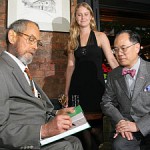
It was a strange affair. Looking round the crowded room in the Foreign Correspondents Club, I recognised some familiar faces, but mainly it was a new Hong Kong watching curiously the demise of an old legend. There were moving speeches. The Chief Executive of the Hong Kong S.A.R. Government, Sir Donald Tseng, came for fifteen minutes and sat by his side, while flashbulbs popped and the modern press jostled. His wife, Kit, and their two children spoke humorously, trying not to cry - and Kevin, so shrunken I didn’t recognize him managed to nod and weakly wave a hand at the jokes. The past eight days he had just slept, but he roused himself for this, and they dressed him in a smart green grey suit with an outrageous red tie. Kit told me it could be in a few days, a week.
My God, I thought. Only Kevin would organise a wake where the corpse was still alive! Kevin the newshound scooping his own funeral. The bad boy going out on a party. One by one we sat down by him and were photographed with him. He couldn’t speak, so the shake of the hand and the picture was all. The chance for Kevin to say goodbye to his friends. I was the last to press flesh. He was showing visible signs of tiring, so his family bustled round, and he was lifted into a wheelchair - this once shouting, roaring, typewriter throwing man - and was wheeled away, the eyes which had always shown either mischievousness or belligerence now only revealing the pain of the illness he had fought for so long.
And for the rest of the evening in my hotel room – I’d cancelled plans to go out on the town after that – I could only think what the loss would mean of such a great character and public figure, whose gaping hole in the throat and croaking voice was an emblem of courage (he had fought his cancer, clocking up victory after victory, for THIRTY years). His passing would leave an empty space. Nobody else had recorded the daily ups and downs of Hong Kong as he had. For all his outrageous prejudices and contradictions, his love of sometimes the most dubious heroes (as long as they were colourful that was fine), and his burning sense of social justice that also sometimes clouded his objectivity, Kevin gave us the truth as he saw it. His “Conversations” and his columns and his books together made him a chronicler of Hong Kong that put him in the league of such greats as Maurice Collis, Austen Coates or Dick Hughes. He too had formed our unconscious view of the city we lived in and its history. There was a fighting, irrepressible decency, an enthusiasm about him that underpinned his wild flamboyance and had made him a legend if not an institution since his thirties. He was quite the most brilliant in sheer staying power of all his journalist contemporaries.
But I was surprised also how personally I felt his coming loss. Although I’d not seen much of him in the last 10 years, I suddenly became aware how much of a fixture he had been in my mental landscape. He’d been my mentor (if that is quite the word) when I joined the SCMP, despite the scathing but humorous criticism you got from him, you knew this was a man who would stand by you to hell and back, he was always counted on to be a good table or drinking companion in the decades that followed, and he’d even been the occasional diarist of my own life – my father’s obituary (I was touched to see in Kevin’s autobiography that he counted PG among his ‘Top 10’ friends), my wedding, my son Alexander’s christening at the Jockey Club, reviews of my books when they came out – all had been subjects for Kevin’s tireless pen. He’d dominated an exuberant part of my life. Oh, and at that book launch/wake, how all those memories came flooding back of a time when we all shared the same idealism and sense of adventure and fun. Well, Kevin had maintained those ideals till his dying day.
We’re a proud brotherhood, those many, many people whose lives he touched. And now he’s gone, the world is that little bit smaller and duller. God bless him.
Kevin has left a wealth of books about Asia behind him, including his autobiography, Tell Me A Story (published by SCMP last week).